What a software factory actually means — and the one question every software owner should ask
“You’re about to be replaced by software factories.” The pitch is everywhere now: coding agents that take a ticket and deliver a reviewed, merged, production-ready change — with no human writing, and often no human reading, the code.
It is the loudest story in software right now. And it’s true that the practice has moved past demos. Real companies run real agent build loops at production scale. But the hype keeps coming back to one image: a dark factory that runs on its own, with humans as an optional extra.
That image is mostly wrong. Here’s what a software factory actually is, the five levels of how much human stays in the loop, where the industry is headed, and the one question every software owner should ask before their company runs on agent-written code.
What a software factory is
A software factory is a system of work where coding agents take on the execution of changes — writing, testing, iterating — started and judged by a harness rather than by a person hand-writing or hand-reviewing every line.
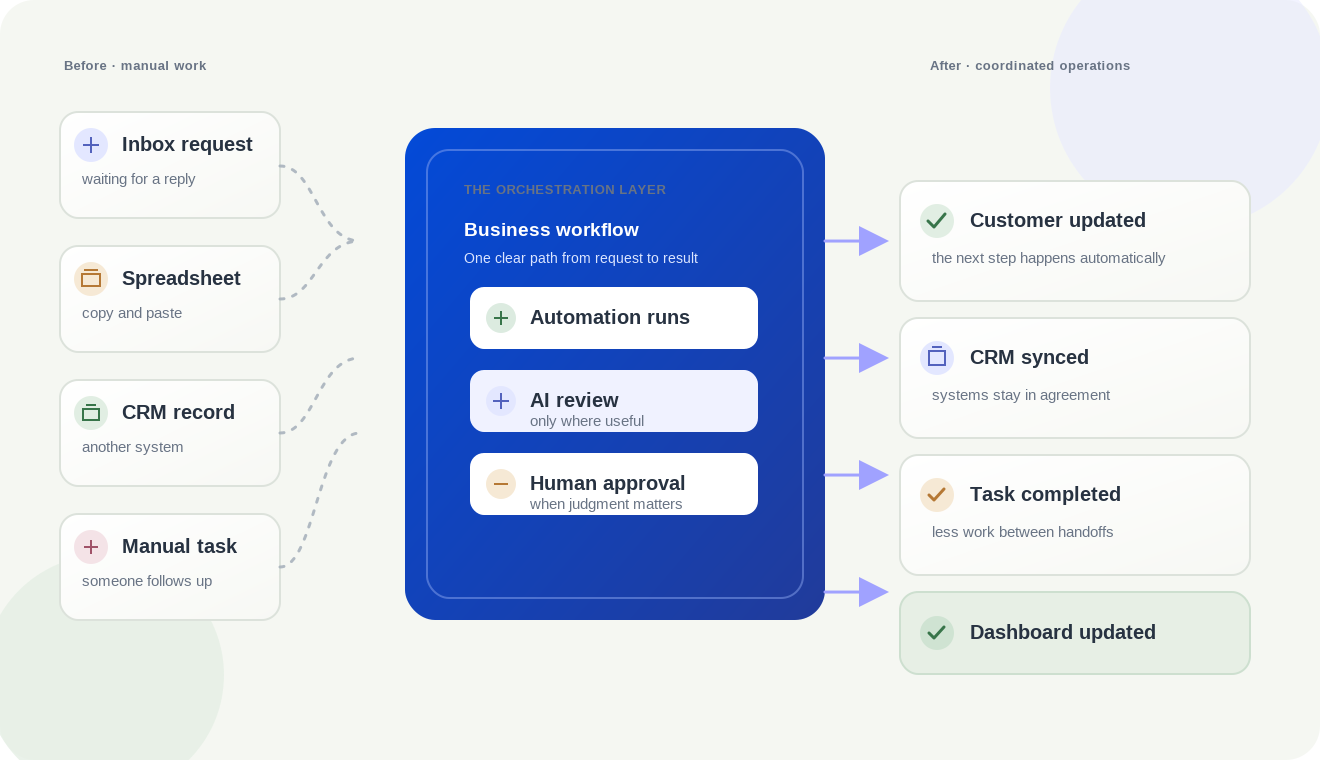
It is one ticket in, one gated change out. A change moves through an automated loop:
- a tool picks up a ticket and runs an agent in an isolated workspace,
- deterministic gates run (tests, builds, evals) and must pass,
- an independent second model reviews the diff against an agreed set of rules,
- only then does the change merge, and the ticket close.
The defining feature is not that agents write the code. It is who decides the code is done. Completion is the merge, gated by machines and an independent reviewer, never the agent’s opinion of its own work.
The five levels
The most useful frame for “how much human is still in the loop” comes from Anthropic’s Dan Shapiro, who adapted the automotive automation levels to AI-assisted programming:
- Level 0 — Spicy autocomplete. AI assists; the code is unmistakably yours.
- Level 1 — Coding intern. You offload discrete tasks like unit tests and docstrings; you still write the substance.
- Level 2 — Junior developer. You pair with the model, hand off the boring work, and review as you go. Most “AI-native” developers live here.
- Level 3 — Developer who manages. Agents write most of the code; you design the work and judge the output.
- Level 4 — Architect / staff-plus. Agents produce most of the code; you define intent at the systems level and verify at the boundary.
- Level 5 — The dark factory. A black box that turns specs into software — dark because humans are neither needed nor welcome.
Everything above level 3 depends on the review system being designed so human judgment is spent on judgment, not volume. As Shapiro puts it, at level 3 “your life is diffs, and for many people this feels like things got worse.” The leverage only shows up once the delegating and review machinery is designed so the human owns intent and validation, instead of line-by-line inspection.
Where the industry is actually headed
The clickbait framing — “Stripe merges thousands of agent PRs a week, OpenAI built a million lines with no human review, Ramp’s agents handle most of its pull requests” — reads like one uniform lights-out claim. It is not.
Only a small minority of operations actually run dark, with no human writing and no human reviewing: StrongDM’s team of three shipping a full product, and OpenAI’s harness team. Both built their own serious verification substrates to make no-review safe — behavioral test scenarios a model can’t game, held out like a training set rather than stored next to the code.
The largest named operations (Stripe, Ramp, Google, Anthropic) all keep a human at the merge boundary, or at an engineering-appeal level. Google’s engineers still approve; Anthropic keeps a human layer on top of agent review; Stripe reviews every one of its agent PRs.
The frontier is not “remove humans.” It is moving the human to where judgment matters, and making everything else deterministic. That is the reality the hype obscures, and it matters for anyone buying software built this way.
Where the real problem is: what agents leave behind
There is a genuine, evidence-backed concern here, and it is not the one the headlines lead with.
Security gets the loudest worry, and the evidence is actually mixed: pooled agent code can look cleaner than human code on some axes and get reverted less often. The less-solved problem is maintainability.
- Agent adoption causally raises code complexity by about 40%, on peer-reviewed analysis.
- Architectural debt compounds roughly 2.8 times faster than code-level debt; industry analysts project 80% of all technical debt will be architectural by 2027.
- Agents systematically skip the invisible 20%: error handling, observability, architectural consistency. They are rewarded for the happy path: finish the ticket, pass the local test.
- The fix is not “review agent code harder.” The teams that succeed codify their accepted architecture decisions, give them to the agent before it writes, and enforce them mechanically at merge. Same standard for human- and AI-written code. The human moves from inspecting lines to owning intent.
This is the whole argument for keeping a named owner in the loop: the recurring cost of agent-built systems is architecture and comprehension debt, and someone has to own the intent that keeps it from compounding.
Where we sit
We run a software factory for a slice of our own build work. One ticket in, one gated change out. An agent works in an isolated workspace, deliberately isolated, because the mundane failure modes are real: a runner that silently writes to the wrong tree, an agent that “passes” a test written to enshrine its own mistake. We keep it honest with the machinery above: deterministic gates that fail closed, an independent second-model review, and a strict rule that the merge, not the agent, is what completes a ticket.
We do not run dark. We sit deliberately at levels 3–4: agents write most of the code, we define the intent and hold the boundary. The reasons are evidence-based, not nostalgic. Most of what the industry claims about “no review” belongs to a small minority that built bespoke verification substrates; the biggest operators keep a human at the merge. And the measured failure mode of this whole approach, architectural drift and comprehension debt, is exactly the thing a named owner exists to prevent.
Being honest about it: this is not a finished position. The empirical record on long-term maintainability of agent-built systems is young and still settling. We do not claim we’ve solved it. We claim the defensible version of the position: govern intent before generation, enforce structure mechanically, keep a named owner at the boundary. And we hold our own work to it.
The one question to ask
If an agency, vendor, or consultant pitches you software built the agent-first way, here is the question that separates a factory from a factory story:
Who is the named owner who answers for the result, and what do the machines actually prove before a change ships?
Ask what the gate is. “Is it tested” is not a useful answer on its own: tested against what, and can the test pass while the behavior is broken? Ask whether someone can explain a change when production is down, a customer reports a problem, or an auditor asks why a change was allowed. And notice the difference between “trust the agent,” which is what unverified vendors sell, and “trust, but verify against intent and enforced structure,” which is what the strongest operations actually do.
The dark factory is where the marketing points. It is not where the sensible buyers live, and it is not where the strongest builders actually work either.
If you’d like a plain-language read of where your own software — agent-built or not — is producing the kind of debt that compounds, that’s exactly what our free Technical Health Review turns up. It’s a one-hour, no-obligation look at the build, with a named owner walking you through what a range of fixes would cost.