Why an AI-era build costs what it costs

You got two quotes for the same project. One is three times the other. Both vendors are good. What’s going on?
The old explanation — “you get what you pay for” — doesn’t survive contact with 2026. The cheap quote isn’t necessarily corner-cutting, and the expensive one isn’t necessarily premium. The cost of building software changed structurally, and a lot of buyers are still being quoted on last decade’s cost curve.
This is the story of how software gets priced now, and what to look for when a number looks too low — or too high.
Building software stopped being the expensive part
For most of software’s commercial history, a build cost what it cost because production was labor: a landing page was a designer, a developer, and a content pass; an MVP was a team for months. The price of the build tracked the price of the people.
AI-assisted tooling changed the production layer. The raw build — the pages, the forms, the first version of the workflow — now takes days instead of weeks, and the marginal cost is close to zero. Whatever your stack, the machine does the producing. An agency that still prices the machine’s work at senior hourly rates is quoting a cost structure that no longer exists.
That’s the source of the wildly different quotes. Both vendors can be fine. One is pricing 2026 production with 2025 economics.
What still costs money: the gates, not the machine
If production is nearly free, what are you paying for? The same things that kept software running before AI: the judgment around the build.
- UX, design, and brand judgment — decisions that make the thing usable and worth trusting.
- QA and user-acceptance testing — the difference between “it runs” and “it holds.”
- Data and security judgment — what the system can touch, who can see it, what happens if it breaks.
- Accountability — a named owner who answers for the outcome, not a queue of tickets.
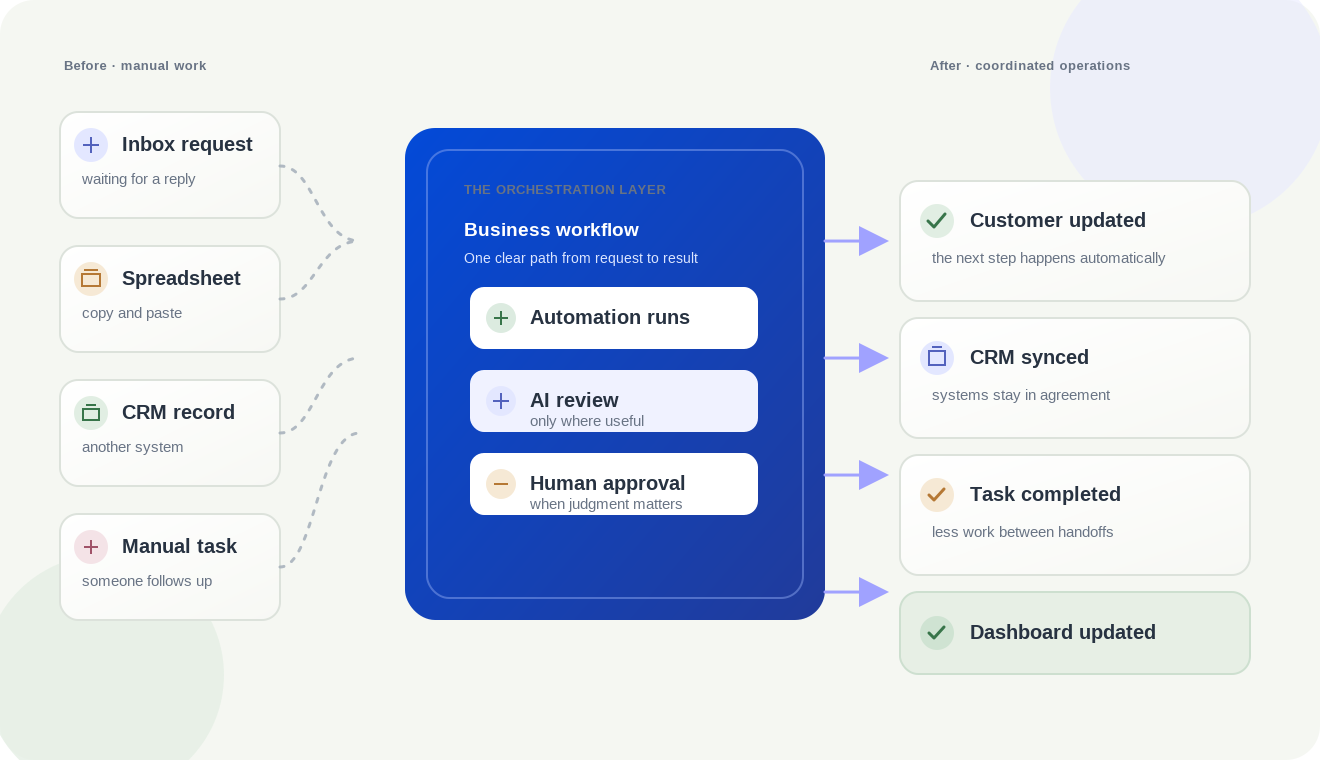
Think of it as a factory: AI is the production line, and these are the quality gates. A factory without gates produces volume. A factory with gates produces products a business can run on.
What that does to prices
Once you price the gates instead of the labor, the numbers move in honest ways:
- A small, well-defined scope is genuinely cheap now. A landing page or a single workflow is minutes of machine time plus a small amount of human judgment. That’s how a content site can start at $800, where it “should” cost three times that by old math.
- As scope grows, the gates grow faster than the production. A custom application, a data platform, an agentic workflow — these are expensive not because the code is hard to generate, but because the judgment is hard to get right: what to build, what not to build, what must never be allowed to fail.
- The rungs where judgment is the product compress least. Taking over a fragile system and making it safe, or running an agent that acts on real records — the machine can’t do those. When a quote on that kind of project is dramatically low, someone has skipped a gate, not found a discount.
How we price, and what we refuse
This is the model behind the published prices: fixed scopes priced on effort, not hourly meters. The bands imply an effective rate for the human portion — the gates — and nothing for the machine’s time.
We don’t sell hours, so we have no reason to be slow. We don’t discount — when a scope is bigger than a budget, we rescope, or say the work isn’t worth doing. Floors are real: the bottom of every band is a small, named scope we can point to before anything is quoted. A $800 content site is a real landing page or three-page site with a CMS and analytics — not a foot in the door.
We’ll also be explicit about the factory’s limits: it’s not a reason to be cheap where judgment is the product. Stabilizing an application your customers depend on is not the same as generating one. An agent that can touch records and message customers is not the same as one that summarizes posts. We’ll tell you which one you’re actually buying.
Reading the number
The next time a quote looks shockingly low or shockingly high, ask what’s in the gates: who does the UX and the QA, who decides what the system may touch, who is accountable when it breaks. The machine makes the build cheap. The gates decide whether the cheap build is a deal or a trap.
If you’re pricing a build right now — or checking whether a quote you already have is honest — the fastest way to ground it is a free Technical Health Review: we’ll scope what you actually need, name what it should cost, and tell you when the right answer is to build nothing at all. No pressure to build; a clear next step either way. See the full build spectrum while you’re here.