Your workflow is genuinely different
Existing tools force you into a process that does not match how your business operates.
Product thinking · practical technology
Custom App Development. When existing tools no longer fit, we design and build focused applications around your customers, workflows, and business goals — from portals and internal tools to MVPs and AI-enabled products. Customer apps · Internal tools · Portals · MVPs · AI-enabled products
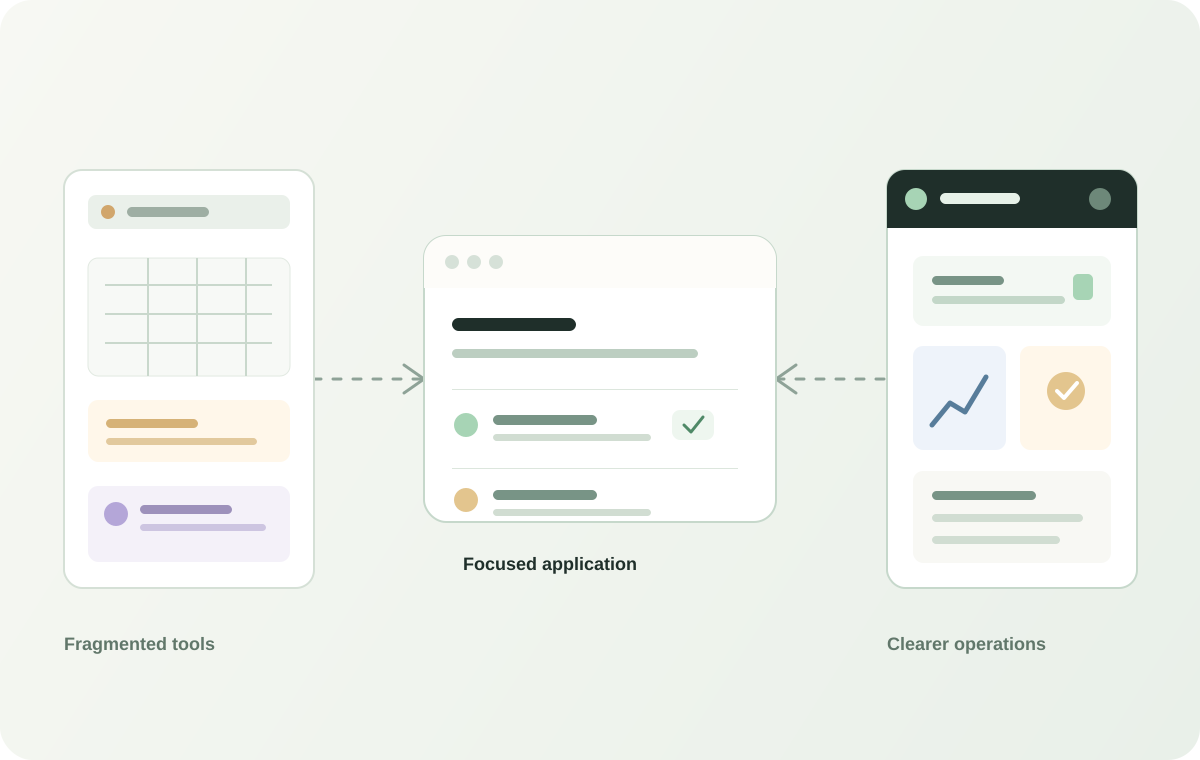
Most businesses should use existing software wherever it fits. But sometimes the compromises start adding up: duplicate data, manual workarounds, awkward customer experiences, missing capabilities, and processes designed around software limitations rather than the business. That's when custom software can become the simpler option. We build custom applications when owning the workflow creates meaningful business value.
The right question
Custom software is worth considering when the compromises have become more expensive than owning a focused solution.
Existing tools force you into a process that does not match how your business operates.
A generic portal or form does not provide the experience you want customers to have.
Your team moves information between multiple systems just to complete one workflow.
A critical process still depends on spreadsheets, email, copying data, or repetitive coordination.
A better workflow, customer experience, or capability can differentiate the business.
A product or business concept needs a real-world MVP before a larger investment.
Focused applications that make an important customer experience or business workflow easier to run.
Customer portals
Client, resident, partner, and membership portals for documents, status, requests, payments, and communication.
Internal tools
Case management, approvals, operational dashboards, intake systems, and workflow tools designed around your process.
Workflow applications
Request, validation, review, action, notification, and audit workflows with clear ownership at every step.
Founder MVPs
The smallest useful product, built for fast iteration without premature scale engineering.
AI-enabled applications
Document understanding, decision support, intelligent search, conversational experiences, or bounded workflow agents — where useful.
Building software creates ownership and flexibility — but also responsibility. If an existing product solves the problem well, we'll tell you to use it. If a few integrations or automations can close the gap, we'll recommend that before custom development. We build when the value of owning the workflow outweighs the cost and complexity of maintaining it. Use existing software where it fits. Build where it creates leverage.
Modern development, responsible operation
We use AI-assisted development to accelerate design, implementation, testing, and iteration while applying engineering judgment where reliability, security, data, and critical workflows matter.
Use predictable rules when the workflow is known and reliability matters most.
Use AI to understand unstructured information, reason across context, make recommendations, or coordinate variable workflows.
Keep people involved for important approvals, exceptions, uncertain decisions, and high-impact actions.
Fast development is valuable. Testing, secure data, clear ownership, and operational discipline make the result useful.
The application follows the business problem. The examples below are patterns, not fixed packages or promises.
Professional services
A client portal with secure uploads, intake, project status, invoices, and communication — creating a more professional experience with less administration.
Property / community management
A request portal with case creation, assignment, status, documents, and notifications — giving teams clearer accountability.
Growing business
Intake, workflow, approvals, integrations, dashboards, and audit history for more consistent operations.
Founder
A focused MVP with authentication, the core workflow, payments where needed, and analytics to learn from real usage.
We keep the work focused on meaningful value, real users, and the level of engineering the business can responsibly own.
Clarify the problem, users, workflow, constraints, and what success actually means.
Identify the smallest product that creates meaningful value.
Define the experience, workflows, data, integrations, and operational requirements.
Implement and iterate using modern AI-assisted development and proven engineering practices.
Validate critical workflows, production setup, monitoring, ownership, and operational readiness.
Learn from real users and evolve the product based on actual business value.
A ten-person company usually does not need architecture designed for a Fortune 100 enterprise. But a customer-facing application also deserves more care than a disposable prototype. We make engineering decisions based on business importance, expected usage, data sensitivity, cost of failure, expected rate of change, and future growth. Enough engineering to be dependable. No architecture theater.

Once customers or employees depend on an application, someone should be responsible for its health.
Production ownership
Monitoring, error visibility, backups, secure access, critical workflow testing, deployment discipline, and clear application ownership.
A practical next step
A Production Readiness Review can identify operational priorities without turning a focused application into an enterprise project.
Improve the workflow
Business Automation can simplify repetitive steps, connect systems, and add AI or agents where they create leverage.
Keep learning
Read what changes after launch in our guide to operating AI-built applications.
You do not need a technical specification. Start with the business problem and the workflow around it.
Good fit
Manual workarounds are becoming expensive or fragile.
Good fit
Multiple tools are required to accomplish one important job.
Good fit
Software could become a meaningful operating advantage.
Not every problem needs custom software
We would rather recommend the simpler answer than build software your business does not need.
We evaluate the business problem first, then recommend the simplest reliable path.
FAQ
Custom development makes sense when owning the workflow creates more value than the cost and responsibility of building it. We evaluate existing software and simpler automation options first.
FAQ
Yes. We prefer evaluating and improving what already exists before recommending a rebuild.
FAQ
It depends on scope and complexity. We identify the smallest useful product rather than committing to unnecessary features upfront.
FAQ
Yes. AI-assisted development helps us move faster, while engineering judgment guides architecture, security, testing, data, and operational decisions.
FAQ
Depending on the application, we can help with production readiness, monitoring, improvements, maintenance, and ongoing technical ownership.
Start with the business problem.
Tell us about the workflow, customer experience, or product idea you're trying to improve. We'll help determine whether the right answer is custom software, automation, an existing platform, or something in between.
Talk About Your App