Repetitive data entry
The same information is copied between forms, spreadsheets, CRMs, and other systems.
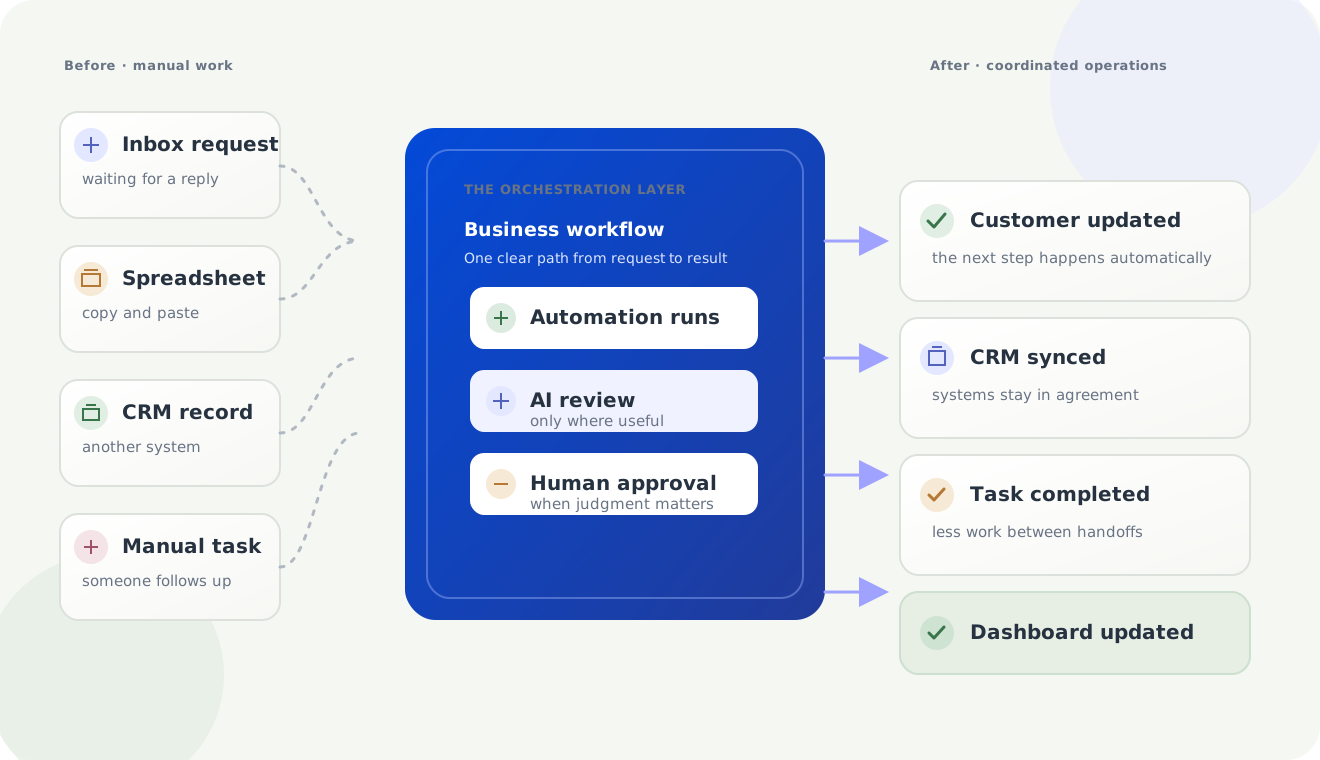
We simplify repetitive workflows, connect disconnected systems, and use automation, AI, and agents where they create real leverage — with people kept in the loop where judgment matters.
Clear priorities. Practical next steps. No pressure to build.
Published investment
$2,000–$6,500
Connecting the tools you already use and automating the steps between — intake, routing, approvals, follow-ups. Rules where answers are predictable, AI where understanding is needed, humans where judgment matters.
See the full pricing ladderProcesses that work with ten customers often start breaking with a hundred. More requests mean more copy-paste, follow-ups, spreadsheets, and people checking whether someone else finished the task. Before adding more people to a repetitive process, we look for the work your systems should be doing instead.
Where is your team losing time?
We look for operational friction that makes customers wait, creates avoidable errors, or forces the team to scale through headcount.
The same information is copied between forms, spreadsheets, CRMs, and other systems.
Work waits for someone to notice an email, assign a task, or update another person.
Teams repeatedly answer, confirm, remind, notify, and follow up by hand.
People spend time collecting information before they can make routine decisions.
Most work follows a pattern, but edge cases force everything to remain manual.
Volume increases and the default answer becomes hiring another person.
Practical workflows can remove administration without taking judgment away from the people who need to use it.
Customer intake
Validate, enrich, route, create a record, notify the team, and acknowledge the customer.
Lead management
Qualify, update the CRM, assign ownership, personalize follow-up, and escalate when needed.
Document workflows
Extract information, classify, validate, request human review when needed, and archive.
Customer support
Understand intent, retrieve context, resolve routine issues, and escalate complex ones.
Operational approvals
Gather context, apply rules, recommend with AI where useful, then capture human approval.
Internal operations
Coordinate status tracking, notifications, data synchronization, and exception handling.
The right tool for the right work
The goal isn't maximum automation. It's the right automation.
Deterministic software is faster, cheaper, and easier to trust when logic is known and repeatable.
Use AI to interpret documents, summarize information, classify requests, or generate recommendations.
Agents can reason about the next step, coordinate systems, and perform bounded actions when work is ambiguous.
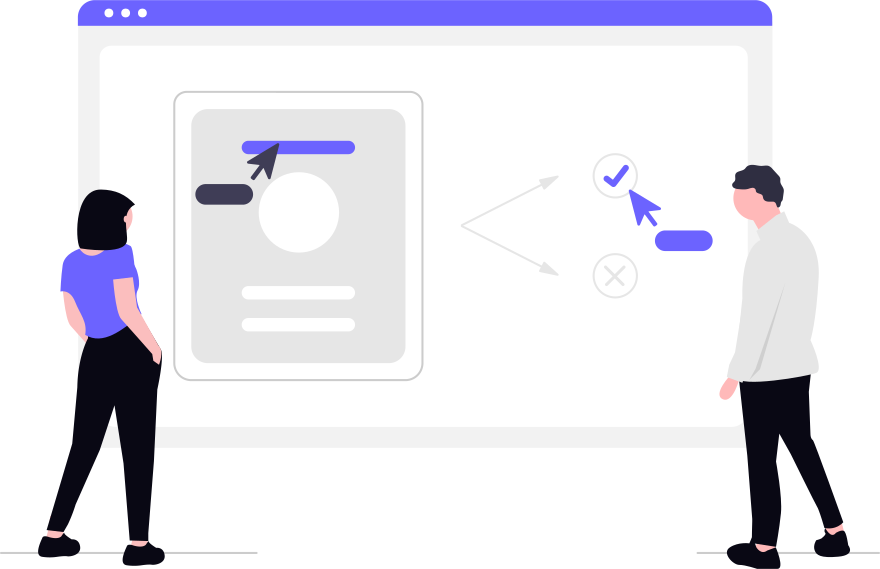
Keep humans involved for unusual cases, important approvals, low-confidence decisions, and meaningful impact.
Some of the best workflows aren't fully autonomous — the system gathers information, handles routine work, and prepares the decision, and a person steps in only when their judgment adds value. People should spend their time on judgment, relationships, creativity, and exceptions — not moving information between systems.
Operational leverage
The result should be a business that scales better — not simply a business with more automation.
Handle more customers and transactions with the same team.
Reduce waiting between steps and systems.
Processes execute the same way instead of depending on memory.
Reduce repetitive work, coordination overhead, and manual error.
We keep the process practical, visible, and tied to the work your business actually needs to do.
Map what happens today, including systems, people, decisions, exceptions, and bottlenecks.
Remove unnecessary steps and clarify the workflow before automating anything.
Decide what should use software, rules, AI, agents, or human judgment.
Connect systems and implement the workflow.
Observe what happens in practice and refine bottlenecks, exceptions, and opportunities.
A professional services firm can keep its expertise while the system handles the administration around it.
Before
Someone downloads attachments, creates a folder, updates the CRM, checks for missing information, emails the client, assigns the account, and creates internal tasks.
After
Documents are classified, information is extracted, missing information is detected, the CRM is updated, and the customer is contacted automatically.
Human review
A professional reviews unusual cases, then the system assigns work and records the decision.
The result
The system handles the administration surrounding it.
Sometimes the solution is connecting systems you already use. Sometimes it's a small custom application. Sometimes deterministic automation handles nearly everything. And sometimes AI or agents unlock workflows that were not practical to automate before. We choose based on reliability, complexity, cost, and business value — not what's fashionable.
You do not need to know what technology you need. You only need to know where the work is getting stuck.
Good fit
Important processes live across email, spreadsheets, and multiple SaaS tools.
Good fit
Customers wait while internal steps happen manually.
Good fit
You suspect AI could help but aren't sure where it belongs.
Not a fit yet
If the process is unclear or unnecessary, the first step may be simplifying it.
We choose the simplest reliable approach for the workflow and the business around it.
FAQ
Any repeatable workflow — intake, follow-up, data movement, documents, approvals, reporting, coordination.
FAQ
No. Many workflows are better solved with conventional automation. We use AI only when it adds useful capabilities.
FAQ
The goal is to remove repetitive work and increase employee capacity. Human judgment remains where it creates value.
FAQ
Usually. We prefer improving and connecting existing systems when that is simpler than replacing them.
FAQ
That's a different rung on the build ladder — AI and agentic builds have their own page, prices, and guardrails.
Show us the workflow that's slowing you down.
Walk us through the process, the tools, and where the team spends time — we'll identify what should be simplified, automated, AI-assisted, or left human.
Book a free review