AI agents in 2026: what they actually take to run safely
Every founder is being pitched an agent right now.
The pitch is usually right about what’s possible and silent about what it takes to run one safely. An agent that drafts follow-ups is interesting. An agent that can email a customer, update a record, or move money is an operational change, not a feature — and operational changes deserve a field guide, not a demo.
This is that guide.
First, the decision framework: rule, capability, or agent?
Most business automation doesn’t need an agent. There are only three ways to make software do work:
- A rule, when the answer is predictable. Cheaper, faster, easier to trust.
- An AI capability, when the software needs to understand something — a document, a request, a question — and the answer stays inside the workflow.
- An agent, when the work itself is variable: the next step can’t be written down in advance, and the system may need to act across tools.
An agent earns its place when three things are true: the workflow is defined, the volume is real, and someone is accountable for the outcome. If the process is unclear or broken, an agent makes it fail faster. If the volume is tiny, a rule (or a person) is cheaper. If no one is accountable, the agent is a liability dressed as efficiency.
A useful honesty check: much of what’s sold as “agentic” in 2026 is a workflow with a language model doing one step. That’s an AI capability (the middle option), not an agent — and it’s often the right answer.
The six guardrails that make an agent safe to run
The difference between a demo and a system a business can run on is never the model. It’s what surrounds it. Six guardrails, in plain language:
Bounded data. The agent sees only what the workflow requires — nothing else. Client records, contracts, and prompts stay inside boundaries you define, and those boundaries are documented, not assumed.
Grounded answers. Output ties back to sources you can check. When an agent summarizes a case or recommends an action, you can see where it came from — instead of accepting smooth talk you can’t verify.
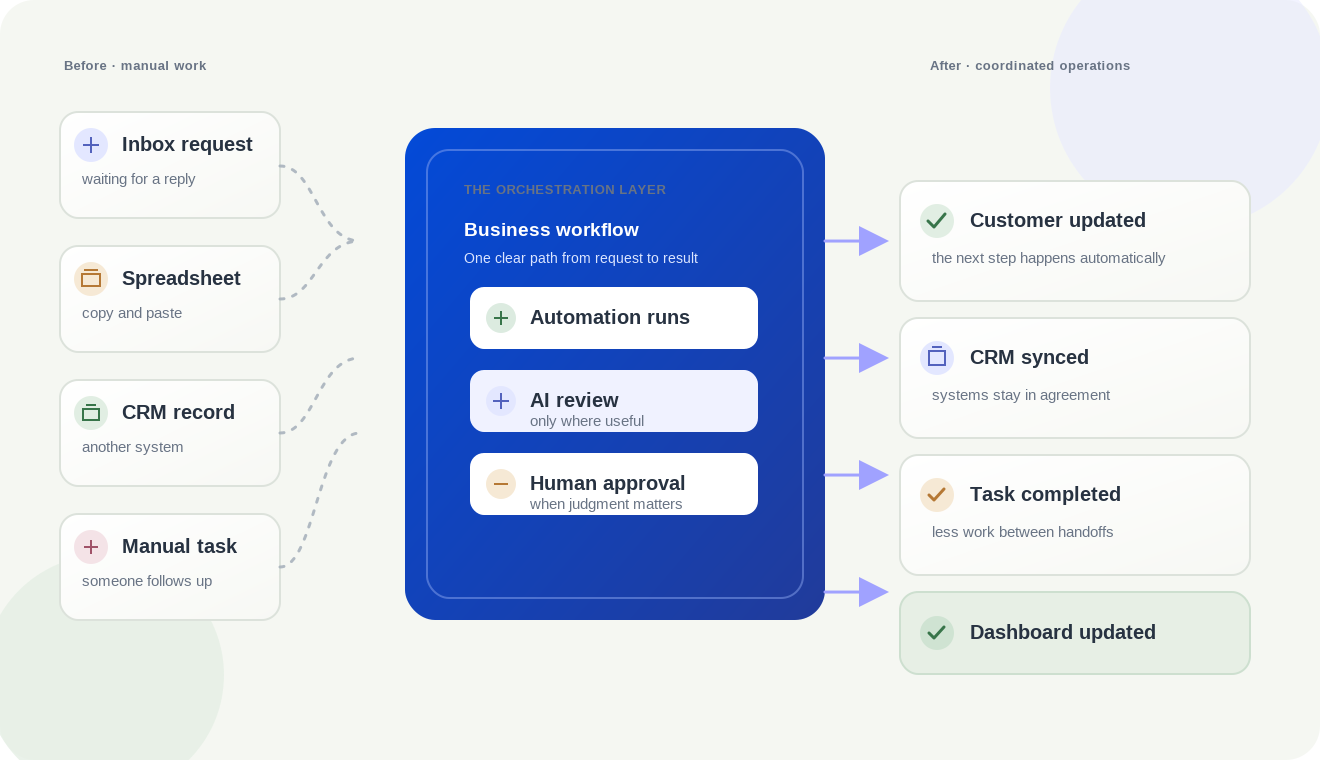
Human approval gates. Consequential actions — messaging a customer, changing a record, moving money — require a person. The agent prepares, a human approves.
Audit trails. Every action is recorded. “Why did the system do that?” always has an answer, and the trail survives the people who were around when it happened.
Evals that gate every change. Before anything ships, a fixed evaluation harness re-runs the scenarios that matter — the happy path, the edge cases, the failures we’ve already seen. The harness, not the model, is what keeps an agent reliable as it changes; it grows every time something goes wrong. Quality here is the whole game: a weak harness blesses bad changes with confidence.
A kill switch. The system can be stopped and handed to a human in one action. Someone is always accountable — not a model, not a committee, a named owner.
How to evaluate an agent pitch: five questions
Before you buy, ask these and insist on specific answers:
- What can it touch? Exactly which tools, records, and permissions? If the answer is “whatever it needs,” walk away.
- Who approves what? Name the actions that require a human. If there are none, the vendor is describing a robot, not a colleague — and you’re describing an unacceptable risk.
- What happens when it’s confidently wrong? The model will be wrong with full confidence. How is that detected, and what does recovery look like?
- How is it tested? Where is the evaluation harness — the fixed set of scenarios re-run before every change — and what does it say about the last change that shipped?
- Who owns the audit trail — and who is accountable? The trail has to exist, and a person has to be on the hook for what the agent does. No named owner, no deal.
The honest conclusion
Agents are an operational decision, not a technology decision. The right starting point isn’t “which agent should we build” — it’s “which workflow, and who’s accountable for it.” Start there, and an agent may or may not follow. Start with the agent, and you’ll learn the workflow problem the expensive way.
That’s the same discipline we apply to every build: define the outcome, name the scope, and put a named owner at the end of it. If you’re being pitched an agent — or wondering whether your operation is ready for one — the fastest way to find out is a free Technical Health Review. It tells you what’s worth building, what can wait, and whether your process is mature enough to hold one. No pressure to build; a clear next step either way.
See where agents sit on the build spectrum, or read about how AI and agentic builds are structured before you have the conversation.