Who Owns Your Lovable App After Launch?
Use this checklist before customers depend on the application. The goal is simple: the business should control the accounts, information, and decisions it needs to keep operating.
You may not need a development team
Hiring engineers may be unnecessary for a small application. Some apps need very little ongoing engineering once they are configured well.
Having nobody responsible for software your customers depend on is a different matter.
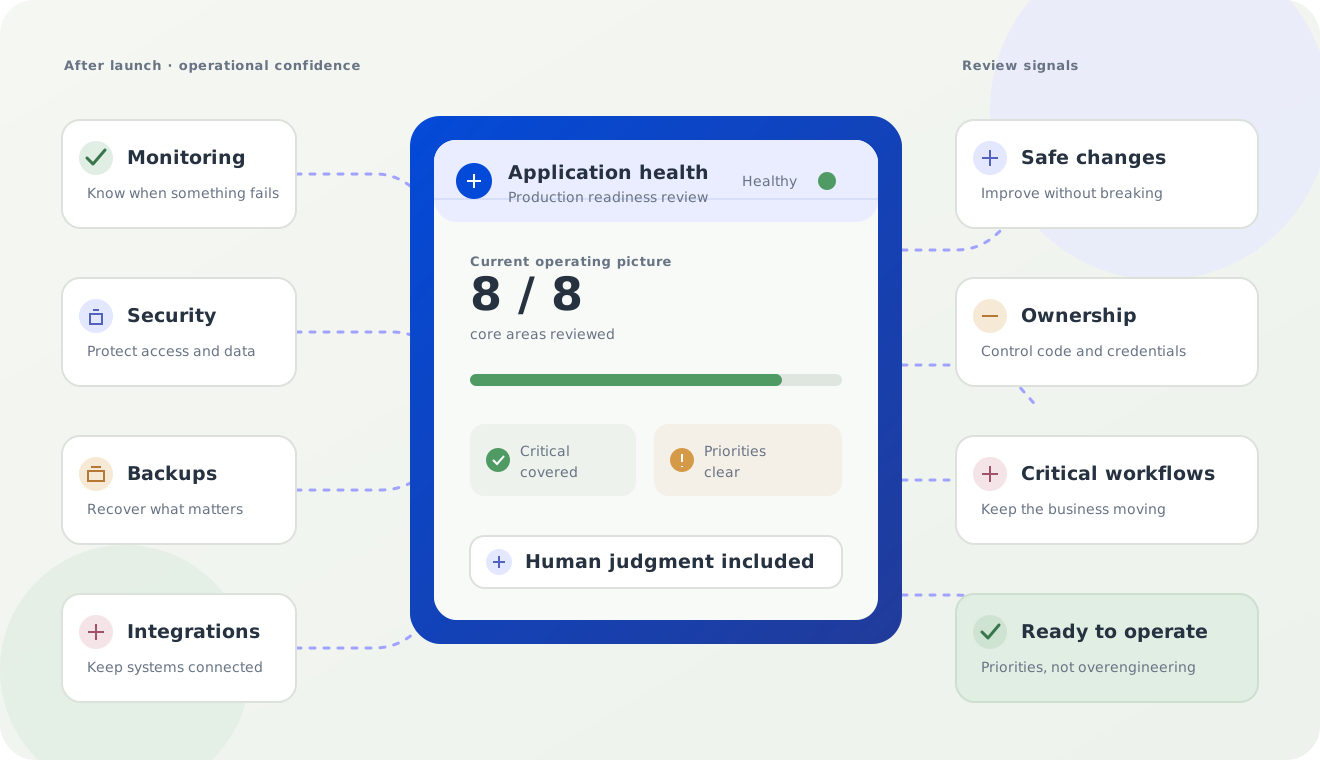
You may need a technical owner rather than a development department. That person is accountable for the health of the system and knows when to bring in deeper expertise. The role may include:
- reviewing application health periodically;
- ensuring monitoring exists;
- diagnosing incidents;
- reviewing significant changes;
- checking security;
- validating backups;
- handling integrations; and
- advising when the architecture needs to evolve.
The technical owner does not have to personally write every fix. They do need to know what is happening and what decision comes next.
Check ownership before there is a problem
Ownership is easiest to ignore while everything is working. The domain resolves, the deployment succeeds, and the right person can sign in, so the arrangement feels adequate. The weakness appears later: a renewal email goes to a former contractor, a payment provider asks for verification, a deployment needs an account that nobody else can access, or a security incident requires credentials that live in one person’s password manager.
A simple inventory turns that hidden dependency into a conversation. List each account, identify the business owner, record who has administrative access, and note where recovery information is stored. The exact arrangement can vary, but the business should be able to keep operating if one individual becomes unavailable.
Ownership also includes understanding the boundaries between services. Source code may live in a repository while deployment is managed by a hosting account. Customer records may live in a database while backups are stored elsewhere. Analytics may be configured in one account and billing in another. A useful inventory follows the path of the business workflow instead of stopping at the application code.
This does not mean every founder needs to manage infrastructure personally. A technical owner, contractor, or agency can operate systems day to day. The business should still control the accounts and information needed to change providers, recover access, understand the data, and make an informed decision about future work.
The same principle applies to decisions, not only credentials. Keep a short record of why important services were chosen, which workflows depend on them, and what constraints shaped the current setup. That context makes future changes safer because the next person can distinguish a deliberate tradeoff from an accidental leftover. It also makes outside help more efficient: a technical partner can spend time evaluating the real problem instead of reconstructing basic facts from scattered accounts and old messages.
Review the inventory whenever the application adds a payment flow, stores a new kind of customer information, changes hosting, or gains a new person with administrative access. Those events change the system’s ownership surface. A lightweight, current record is more useful than a detailed document that nobody revisits.
A practical handover conversation
Ask four questions for every important asset: Who owns it? Who can access it? How would access be recovered? What would have to change if the current technical partner stopped helping tomorrow? Unclear answers are not automatically a crisis, but they are useful findings to prioritize before the asset becomes business-critical.
Record the result in a place the business controls, keep sensitive secrets out of ordinary documents, and review the inventory after major changes. The goal is not paperwork for its own sake. The goal is to avoid a single point of failure in the accounts, code, data, and services that make the business work.
These topics are connected. The questions tell you what to inspect, the readiness scale helps you decide how much care is proportionate, and the ownership checklist shows who must be able to act when something changes. Read the five-level readiness scale and the ownership checklist alongside this guide. For the broader argument, return to the Lovable launch guide.